Page 1 of 2
XMP: Getting a Protocol from IRScope
Posted: Tue Apr 14, 2009 8:29 am
by alanrichey
Hi
I am trying to learn the codes for a Grundig DTR-8720 using an IR Widget and IRSCOPE. The key codes are being recognised, as is the Device Number (42.17), but the protocol displayed is :
XMP:139.xxx-0B1F442A14810200
where xxx seems to vary (The Harmony remote defaults to sending a code 5 times, so I get 5 values.)
All the documentation I have read seems to assume you have a proper JP1 Remote and are using IR.EXE. Is there any way of decoding a protocol to use in RemoteMaster using those values or the waveform readout ?
Al
Posted: Tue Apr 14, 2009 9:02 am
by johnsfine
I hope that happened because you're using an obsolete version of DecodeIr.dll, because otherwise it probably represents a bug in DecodeIr.dll
XMP signals are very hard for learning remotes to capture correctly, and with a learning remote it is common to have XMP signals only partially decoded as that one was. But the IR Widget should do a much better job than a learning remote.
From the overall format of that string, I can see DecodeIr thinks that XMP signal was learned with an error in it.
From the "0B1F442A14810200" portion, I can tell the signal is either correct or has an unusual kind of large error. More likely correct.
That whole string XMP:139.xxx-0B1F442A14810200 represents just the second half of one XMP signal. You didn't give enough info for me to guess what happened to the first half. (But each half of an XMP signal has all the information if learned correctly. Looking at the other half is only important if the learn is bad and you need redundant info to interpret it.)
Does just that xxx vary or do some of the hex digits vary as well?
The xxx is DecodeIr.dll's estimate of the timing distortion in the learn. Despite the "." it is an integer value, not a fraction. I would have expected a two digit xx not three digit. A three digit value would represent a high level of timing distortion, which I would not expect from IR Widget.
Anyway, the correct protocol is "XMP". I assume you want a Slingbox upgrade. I think that might be tricky (upgrade size issues). Hopefully, Rob will give you some guidance on that.
After I see what Rob suggests (or find his old posts on XMP for Slingbox if he doesn't join this thread soon), I probably can tell you how to interpret any problem decodes you get from IR Widget well enough to include them in an upgrade.
Posted: Tue Apr 14, 2009 9:31 am
by alanrichey
Hi John
Thanks for the swift reply. Always good to hear from the author

I'm using V2.36 downloaded from the JP1 Tools. Is there a newer one?
I've just done a lot more learns, and have a better handle on what is happening. For any key I get the following 6 readings (The Device is always 42.17):
XMP
XMP.xxx.yyy-0B1F442A1z81qq00
XMP.xxx.yyy-0B1F442A1z81qq00
XMP.xxx.yyy-0B1F442A1z81qq00
XMP.xxx.yyy-0B1F442A1z81qq00
XMP.xxx.yyy-0B1F442A1z81qq00
The xxx is always 139 or 140
The yyy varies between 120 and 300
The q is the hex value of the key
The z seems to vary and I can't see any correlation.
I note from your upgrade notes that the XMP used to be the Dreambox protocol, which is supported by RemoteMaster ?
Cheers
Al
Posted: Tue Apr 14, 2009 9:54 am
by johnsfine
I know what z is. Don't worry about it.
I don't know why yyy would be so big on what are obviously very good captures. But it doesn't seem worth worrying about.
Posted: Tue Apr 14, 2009 10:39 am
by Kevin Timmerman
Could you post an *.ict file or a screen capture? I have some ideas about what the problem may be.
Posted: Tue Apr 14, 2009 11:02 am
by alanrichey
Hi Kevin
Done them both, while learning the '5' key.
https://www.hifi-remote.com/forums/dload ... le_id=6555
Cheers
Al
Posted: Tue Apr 14, 2009 11:07 am
by The Robman
The XMP protocol is a major PITA! It's UEI's $016C executor and it's called "Dreambox" in RM.
Looking at your "0B1F442A14810200" string, "0B1F442A" is the fixed data for the executor. Just FYI, the 2nd character "B" is the first checksum, it's a ADD of all the other characters in the fixed data. This data would give a checksum value of "C", so there's an error in the data. The "F44" portion is the same in every XMP sample that I've ever seen. Apart from the checksum, the only data that really varies by device is the first byte and the last 2 bytes.
The first character of the 2nd half of the string (ie, "14810200") is supposed to be the same as the first character of the 1st half of the string. Your data doesn't match, so either the 1 in the 2nd half is wrong or the 0 in the first half is wrong. If you change the 0 in the first half to a 1, the checksum calculates to a "B", so I'm going to assume that the fixed data should really be "1B1F442A".
The 2nd character in the 2nd half is another checksum, also calculated by ADD'ing all the other characters. You show a "4" but I calculate a "C" so something's wrong here too. Looking at the part2 string in your screen shot "12810400" the checksum is wrong also (you have a "2", I calculate an "A")
There is a toggle in the signal, which turns up in bit3 of the 3rd character of the 2nd string, so this character should alternate between 0 and 8 as the signal repeats.
Depending on the device, either the last 2 bytes, or the next 2 bytes in, are the "OBC" bytes. In this case it's the latter.
Posted: Tue Apr 14, 2009 11:33 am
by Kevin Timmerman
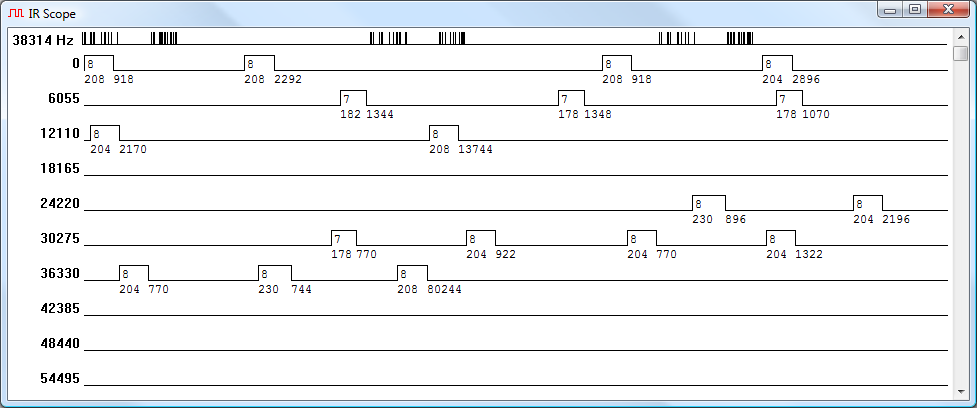
Thanks for the files. The IR Widget likes to have on durations of at least 300 uS and requires on durations of greater than 200 uS. The XMP protocol is right on the edge of the 200 uS absolute minimum. This will cause a bit more jitter in the timing than signals with longer on durations. It looks like the timing is within +/- 10% or so of what is in
this post.
I assume the lack of precision in the IR Widget capture is the cause of the error reported (yyy = 120 to 300) by the IR decoder DLL.
Posted: Tue Apr 14, 2009 11:51 am
by alanrichey
As a rough translation then - 'it's a can of worms'
So does this go into the 'too difficult' folder?
Al
Posted: Tue Apr 14, 2009 11:54 am
by alanrichey
Kevin Timmerman wrote:Thanks for the files. The IR Widget likes to have on durations of at least 300 uS and requires on durations of greater than 200 uS. The XMP protocol is right on the edge of the 200 uS absolute minimum. This will cause a bit more jitter in the timing than signals with longer on durations. It looks like the timing is within +/- 10% or so of what is in
this post.
I assume the lack of precision in the IR Widget capture is the cause of the error reported (xxx ~= 140) by the IR decoder DLL.
I had left the Capture duration at 700ms and held the button down until the capture was completed. I know I can tweak the Harmony to set the number of times to repeat the signal. Is there any mileage in doing that ?
Al
Posted: Tue Apr 14, 2009 12:05 pm
by Kevin Timmerman
It is the duration of each pulse of IR that is on the edge. A longer capture would not help.
I think I can reduce the jitter a bit in a future software version.
Posted: Tue Apr 14, 2009 12:56 pm
by johnsfine
The Robman wrote:"0B1F442A" is the fixed data for the executor. Just FYI, the 2nd character "B" is the first checksum, it's a ADD of all the other characters in the fixed data. This data would give a checksum value of "C", so there's an error in the data.
Oops! That was exactly what I was looking for, yet I missed it. I added the numbers in my head quickly and thought it came out right.
So DecodeIR is correct. The XMP signal is not good enough to be completely decoded without some application of human intelligence. Those high yyy values are accurately reporting a second point of view on the same error that is identified by the wrong checksum.
The first character of the 2nd half of the string (ie, "14810200") is supposed to be the same as the first character of the 1st half of the string.
Boy have I forgotten a lot! I knew that too.
Your data doesn't match, so either the 1 in the 2nd half is wrong or the 0 in the first half is wrong. If you change the 0 in the first half to a 1, the checksum calculates to a "B", so I'm going to assume that the fixed data should really be "1B1F442A".
That all sounds right, so I agree.
The 2nd character in the 2nd half is another checksum, also calculated by ADD'ing all the other characters. You show a "4" but I calculate a "C" so something's wrong here too.
What??
I ignored the word "ADD" the first time because you obviously know what you're talking about. But it is actually an inverse sum. The "4" still looks correct to me.
Looking at the part2 string in your screen shot "12810400" the checksum is wrong also (you have a "2", I calculate an "A")
Same again. I think "12810400" is perfect.
The Robman wrote:"0B1F442A" is the fixed data for the executor ... that the fixed data should really be "1B1F442A".
For an ordinary upgrade (not Slingbox) that observation by Rob was the only hard part. Everything else should be easy.
But Rob may also know if there are extra issues because of size constraints in Slingbox upgrades.
Posted: Tue Apr 14, 2009 1:32 pm
by Kevin Timmerman
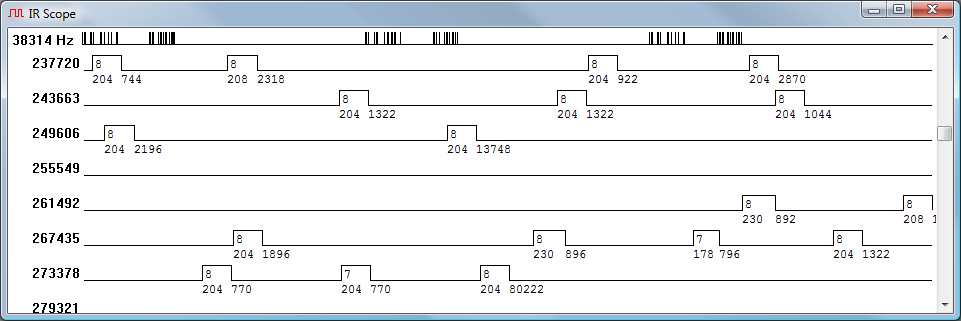
The second and later parts clearly begin with a '0'. Does the decoder assume it will always be '1'? The overall timing is not too bad.
Looks like a new protocol variant or a Harmony error.
Posted: Tue Apr 14, 2009 1:35 pm
by The Robman
You're right about the 2nd part of the signal, the spreadsheet that I was using to calculate the checksum was expecting the first repeat where the toggle nibble would be "0", whereas the data posted is obviously from the 2nd repeat where the toggle nibble is "8".
Also, just for everyone else, here's how you can calculate the checksum:
1) convert each nibble (except for the checksum nibble) to decimal
2) ADD all the decimal values
3) subtract the result from 256
4) MOD it with 16 (ie, divide by 16 and keep the remainder)
5) convert the result back to 1 nibble of hex.
Posted: Tue Apr 14, 2009 1:47 pm
by johnsfine
Kevin Timmerman wrote:The second and later parts clearly begin with a '0'.
The timing certainly looks that way, but ...
Does the decoder assume it will always be '1'?
No it doesn't. The decoder had no clue beyond something is wrong in the first half of the second part.
Rob deduced that it was a '1' by looking at the other info. I still agree with him on that.
The overall timing is not too bad.
I don't know how to read enough from the screen shots you posted. DecodeIr.dll thinks the overall timing is pretty bad.
Looks like a new protocol variant
I think that is WAY down the list of possibilities.
or a Harmony error.
Higher up the list, but still doesn't seem likely.
Are you confident the firmware in the capture device isn't systematically distorting the timing of that pulse?
Edit: I put all the numbers from the .ict file into Excel and examined them in various ways. The data is pretty bad, but that one (we think) wrong digit is three times worse every time than the next worst digit ever is.
So, I'm starting to lean toward the theory that it is a Harmony error.
Most devices receiving XMP ignore a lot of major errors in the signal. So I'd be surprised if there were any symptoms from that error (beyond the decode problem). I've never understood the concepts behind most of the design decisions in XMP protocol. One of those is having a checksum but apparently ignoring checksum errors.