Some protocols are not decodable without repeating magic
Posted: Tue Feb 07, 2023 9:15 am
I'm writing an IRP encoder/decoder in rust, see https://docs.rs/irp/ and https://github.com/seanyoung/cir/tree/main/irp
The encoder is working fine, and produces the same output as IrpTransmogrifier for the protocols defined in IrpProtocols.xml
The decoder generates a fine state machine like regexes. I've got NFA mostly working, with a few minor exceptions. DFA will be next. Note that my decoder works fine with protocols marked decodable=false in IrpProtocols.xml
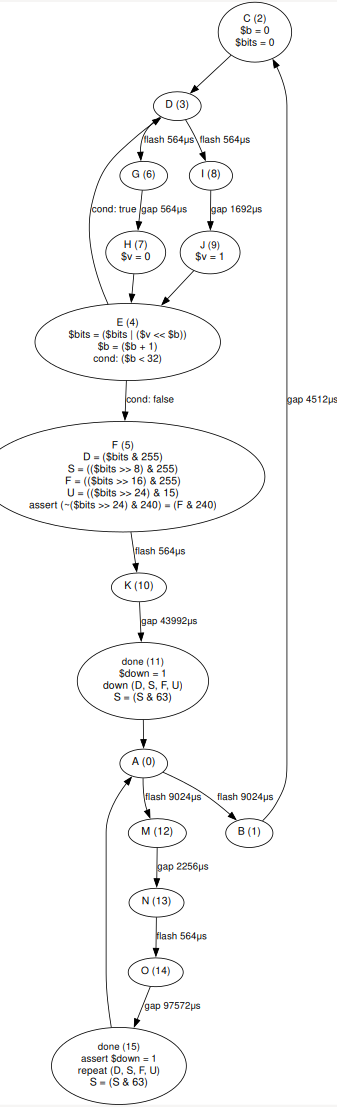
Now, in order to generate a decoder, sometimes I have to jump through some hoops because the way the protocols are written in IRP.
Take DirecTV_3FG for example.
If I split this into down, repeating, and up sections I get:
down: 10,-2
repeating: D:4,F:8,C:4,1,-30m,5,-2
up:
However, down does not work because 10,-2 does not define F and D. After all, I want a decoded down event to actually have usable values. So, my decoder has special code which goes something like this "if the down part does not set the required variables, add a single instance of repeat to down", e.g.
down: 10,-2,D:4,F:8,C:4,1,-30m,5,-2
repeating: D:4,F:8,C:4,1,-30m,5,-2
up:
Now the down decoder can actually give you the value of D & F. See https://github.com/seanyoung/cir/blob/m ... ariants.rs
So now effectively I've re-written:
into
Note * => +
In fact, another way to describe this problem is: if I render the IRP with 0 repeats, then the protocol is not decodable.
A somewhat related issue is the lack of repeat markers in many protocols, e.g. sony8:
So does this protocol really not permit any repeats, you cannot hold a key down on this remote? Seems like nonsense. So, I have a rule: if there is no repeat marker anywhere, assume the whole thing can be repeated. This essentially does:
Hope this makes sense.
How do we feel about amending the protocols so they all make sense wrt having somethign sensible in the down and repeat part?
The encoder is working fine, and produces the same output as IrpTransmogrifier for the protocols defined in IrpProtocols.xml
The decoder generates a fine state machine like regexes. I've got NFA mostly working, with a few minor exceptions. DFA will be next. Note that my decoder works fine with protocols marked decodable=false in IrpProtocols.xml
Now, in order to generate a decoder, sometimes I have to jump through some hoops because the way the protocols are written in IRP.
Take DirecTV_3FG for example.
Code: Select all
{38k,600,msb}<1,-1|1,-2|2,-1|2,-2>(10,-2,(D:4,F:8,C:4,1,-30m,5,-2)*){C=7*(F:2:6)+5*(F:2:4)+3*(F:2:2)+(F:2)}[D:0..15,F:0..255]
down: 10,-2
repeating: D:4,F:8,C:4,1,-30m,5,-2
up:
However, down does not work because 10,-2 does not define F and D. After all, I want a decoded down event to actually have usable values. So, my decoder has special code which goes something like this "if the down part does not set the required variables, add a single instance of repeat to down", e.g.
down: 10,-2,D:4,F:8,C:4,1,-30m,5,-2
repeating: D:4,F:8,C:4,1,-30m,5,-2
up:
Now the down decoder can actually give you the value of D & F. See https://github.com/seanyoung/cir/blob/m ... ariants.rs
So now effectively I've re-written:
Code: Select all
{38k,600,msb}<1,-1|1,-2|2,-1|2,-2>(10,-2,(D:4,F:8,C:4,1,-30m,5,-2)*){C=7*(F:2:6)+5*(F:2:4)+3*(F:2:2)+(F:2)}[D:0..15,F:0..255]
Code: Select all
{38k,600,msb}<1,-1|1,-2|2,-1|2,-2>(10,-2,(D:4,F:8,C:4,1,-30m,5,-2)+){C=7*(F:2:6)+5*(F:2:4)+3*(F:2:2)+(F:2)}[D:0..15,F:0..255]
In fact, another way to describe this problem is: if I render the IRP with 0 repeats, then the protocol is not decodable.
Code: Select all
$ cir transmit irp --dry-run '{38k,600,msb}<1,-1|1,-2|2,-1|2,-2>(10,-2,(D:4,F:8,C:4,1,-30m,5,-2)*){C=7*(F:2:6)+5*(F:2:4)+3*(F:2:2)+(F:2)}[D:0..15,F:0..255]' -f D=0,F=0 -r 0
info: carrier: 38000Hz
info: rawir: +6000 -1200
Code: Select all
{40k,600}<1,-1|2,-1>(4,-1,F:8,^45m)[F:0..255]
Code: Select all
{40k,600}<1,-1|2,-1>(4,-1,F:8,^45m)+[F:0..255]
How do we feel about amending the protocols so they all make sense wrt having somethign sensible in the down and repeat part?