StephenR0 wrote:So, I would like to build something from an Arduino that will work with the sketch that you have provided. I have Arduino Nanos. I understand that I should use capture pin 8. Should I use an OPL-551 for this or something else. If not an OPL-551, what part do you suggest to work with your sketch? Thanks.
Kewl. Yes it is pit 8 in Nano/Uno (pin 4 on Leonardo/Micro, pin 49 on Mega2560). For sending, uses pin 3 on Nano/Uno, pin 9 on Leonardo/Micro/Mega2560.
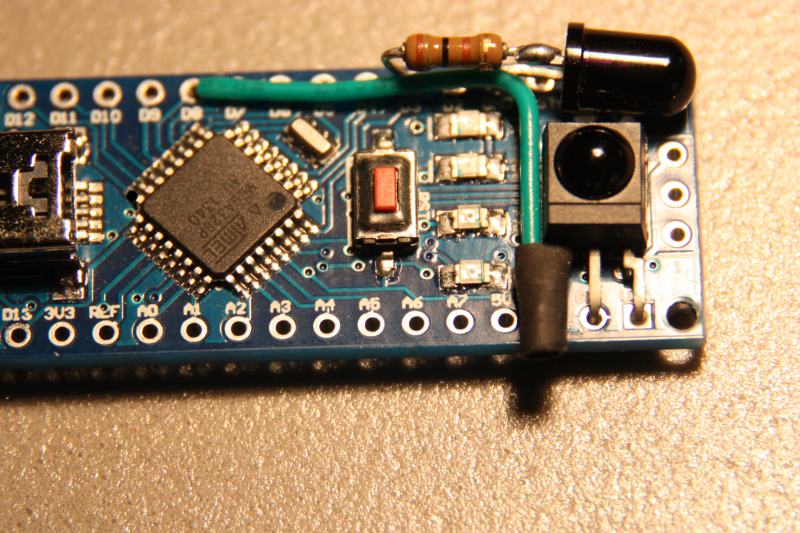
For sensors, it is not really critical. You can use any non-demodulating sensor, inverting or not, open collecor or not: The software finds out if the sensor is inverting, and there is an internal pull-up resistor enabled in the software (open-collector friendly). Some possible alternatives are: OPL-551 (official replacement of the discontinued QSE-159), OP-550, QSE-157, TSMP4138, TSMP1138, TSMP58000, SDP8600,... You can even use a photo diode/transistor or even a normal sending IR-LED. Here is a photo of a creation of mine, soldering a TSMP4138 directly to a Nano:
cauer29 wrote:Does the "MikeT" Arduino solution actually count the raw pulses? Or is it yet another demod pulse width solution?
See his own words in the thread 3FG linked. Basically, a timer is configured so the all the edges are registered, with high precision. MikeT's software has three modes: In raw mode, it sends all this data to the host. This requires too much space on e.g. an Uno to capure e.g. a NEC1. (Fine on a Mega though.) So there is also an "aggregating mode" which lumps them together into busts, while collecting pertinent parameters. This is what is used in the IrScrutinizer.
I had no problem purchasing an IR Toy, but maybe I was lucky?
I also got mine (two actually) within a day or two from the German firm i linked to. Do not get me wrong: I would love if the 'toy was to be had easily. Nice price, the right sensors and LED, open source and open hardware, possibility to write your own firmware. That is great! Just too bad if it has to be ordered from Asia, and is out of stock "often".
hanryz wrote:Hi Barf, I tried the receiver and sender sketches yesterday and it worked. I could receive, decode and correctly send codes. No hangs whatsoever. The other sketches I didn't try as they do not seem relevant at the momen
Nice. But what "other sketches"? There should be only GirsLite, Did some unintended junk slip through my packaging?
However, one problem exists: I noticed that it takes very long (1 min) to open the port on configure hardware tabs of the GUI. Apparently the IrScrutinizer waits for a certain string to be returned and which is not sent by the sketches. I could not identify this string by a quick look into the sources of the IrScrutinizer.
Try this: In the device mangager, check if there are "junk" entries under serial connections (COM) etc. Often, Bluetooth, ISDN, cell phone stuff, etc creates their own virtual serial ports there, since they believe that the user needs it. Try to delete all junk virtual ports there. I believe that RXTX (the java communication library) needs a lot of time listing the available serial devices in the presence of more-or-less functional pseudo-devices. (I did this on my windows 7 laptop, and the startup time went down from some 20 seconds just to a few seconds, just like on Linux).
You can also turn on the opion "verbose" in the options menu, that will give you some hint on what is going on, and may help debugging weird delays.
BTW, I should say that I have made quite some changes to MikeT's firmware, in particular refacturing the class structure. These changes have not been blessed (nor criticized) by him. Bugs etc are thus possibly introduced by me.
